Ebook Download Physics for Scientists and Engineers with Modern Physics: Volume II (3rd Edition) (Physics for Scientists & Engineers)
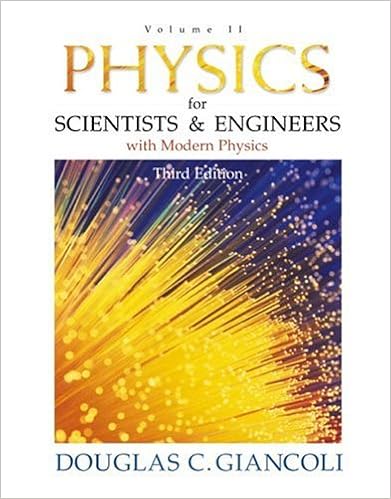
Physics for Scientists and Engineers with Modern Physics: Volume II (3rd Edition) (Physics for Scientists & Engineers)

Ebook Download Physics for Scientists and Engineers with Modern Physics: Volume II (3rd Edition) (Physics for Scientists & Engineers)
When someone reads a publication in a sanctuary or in waiting listing place, exactly what will you think about her or him? Do you really feel that they are type of arrogant people that do not care of the area about? Actually, individuals that are reading wherever they are might not seem so, but they may become the focal point. Nevertheless, exactly what they suggest occasionally will certainly not as like exactly what we assumed.
For everybody, if you wish to start joining with others to check out a book, this Physics For Scientists And Engineers With Modern Physics: Volume II (3rd Edition) (Physics For Scientists & Engineers) is much suggested. As well as you need to obtain guide Physics For Scientists And Engineers With Modern Physics: Volume II (3rd Edition) (Physics For Scientists & Engineers) below, in the link download that we provide. Why should be here? If you really want other sort of books, you will always find them as well as Physics For Scientists And Engineers With Modern Physics: Volume II (3rd Edition) (Physics For Scientists & Engineers) Economics, national politics, social, scientific researches, religious beliefs, Fictions, and a lot more books are supplied. These offered books are in the soft files.
From the combo of understanding as well as actions, somebody can improve their ability as well as ability. It will certainly lead them to live and also work much better. This is why, the pupils, employees, and even employers should have reading habit for books. Any type of publication Physics For Scientists And Engineers With Modern Physics: Volume II (3rd Edition) (Physics For Scientists & Engineers) will certainly provide specific understanding to take all advantages. This is exactly what this Physics For Scientists And Engineers With Modern Physics: Volume II (3rd Edition) (Physics For Scientists & Engineers) informs you. It will certainly include more expertise of you to life and also function far better. Physics For Scientists And Engineers With Modern Physics: Volume II (3rd Edition) (Physics For Scientists & Engineers), Try it as well as show it.
Alleviate of the language and also simple jobs to recognize end up being the factors of many individuals try to get this book. When you wish to find more concerning Physics For Scientists And Engineers With Modern Physics: Volume II (3rd Edition) (Physics For Scientists & Engineers), you can see who the writer is, who the individual that has actually created the book is. Those will be far more remarkable. Thus, you could check out the web page with the web link that we provide in this article. It will not be so complicated for you. It will certainly be a lot easier to acquire.
From the Inside Flap
PREFACE A Brand New Third Edition It has been more than ten years since the second edition of this calculus-based introductory physics textbook was published. A lot has changed since then, not only in physics itself, but also in how physics is presented. Research in how students learn has provided textbook authors new opportunities to help students learn physics and learn it well. This third edition comes in two versions. The standard version covers all of classical physics plus a chapter on special relativity and one on the early quantum theory. The extended version, with modern physics, contains a total of nine detailed chapters on modern physics, ending with astrophysics and cosmology. This book retains the original approach: in-depth physics, concrete and nondogmatic, readable. This new third edition has many improvements in the physics and its applications. Before discussing those changes in detail, here is a list of some of the overall changes that will catch the eye immediately. Full color throughout is not just cosmetic, although fine color photographs do help to attract the student readers. More important, full color diagrams allow the physics to be displayed with much greater clarity. We have not stopped at a 4-color process; this book has actually been printed in 5 pure colors (5 passes through the presses) to provide better variety and definition for illustrating vectors and other physics concepts such as rays and fields. I want to emphasize that color is used pedagogically to bring out the physics. For example, different types of vectors are given different colors—see the chart on page xxxi. Many more diagrams, almost double the number in the previous edition, have all been done or redone carefully using full color; there are many more graphs and many more photographs throughout. See for example in optics where new photographs show lenses and the images they make. Marginal notes have been added as an aid to students to (i) point out what is truly important, (ii) serve as a sort of outline, and (iii) help students find details about something referred to later that they may not remember so well. Besides such "normal" marginal notes, there are also marginal notes that point out brief problem solving hints, and others that point out interesting applications. The great laws of physics are emphasized by giving them a marginal note all in capital letters and enclosed in a rectangle. The most important equations, especially those expressing the great laws, are further emphasized by a tan-colored screen behind them. Chapter opening photographs have been chosen to illustrate aspects of each chapter. Each was chosen with an eye to writing a caption which could serve as a kind of summary of what is in that chapter, and sometimes offer a challenge. Some chapter-opening photos have vectors or other analysis superimposed on them. Page layout: complete derivations. Serious attention has been paid to how each page was formatted, especially for page turns. Great effort has been made to keep important derivations and arguments on facing pages. Students then don't have to turn back to check. More important, readers repeatedly see before them, on two facing pages, an important slice of physics. Two kinds of Examples: Conceptual Examples and Estimates. New Physics The whole idea of a new edition is to improve, to bring in new material, and to delete material that is verbose and only makes the book longer or is perhaps too advanced and not so useful. Here is a brief summary of a few of the changes involving the physics itself. These lists are selections, not complete lists. New discoveries:planets revolving around distant stars Hubble Space Telescope updates in particle physics and cosmology, such as inflation and the age of the universe New physics topics added:new treatment of how to make estimates (Chapter 1), including new Estimating Examples throughout (in Chapter 1, estimating the volume of a lake, and the radius of the Earth) symmetry used much more, including for solving problems new Tables illustrating the great range of lengths, time intervals, masses, voltages gravitation as curvature of space, and black holes (Chapter 6) engine efficiency (Chapter 8 as well as Chapter 20) rolling with and without slipping, and other useful details of rotational motion (Chapter 10) forces in structures including trusses, bridges, arches, and domes (Chapter 12) square wave (Chapter 15) using the Maxwell distribution (Chapter 18) Otto cycle (Chapter 20) statistical calculation of entropy change in free expansion (Chapter 20) effects of dielectrics on capacitor connected and not (Chapter 24) grounding to avoid electric hazards (Chapter 25) three phase ac (Chapter 31) equal energy in E and B of EM wave (Chapter 32) radiation pressure, EM wave (Chapter 32) photos of lenses and mirrors with their images (Chapter 33) detailed outlines for ray tracing with mirrors and lenses (Chapters 33, 34) lens combinations (Chapter 34) new radiation standards (Chapter 43) Higgs boson, supersymmetry (Chapter 44) Modern physics. A number of modern physics topics are discussed in the framework of classical physics. Here are some highlights:gravitation as curvature of space, and black holes (Chapter 6) planets revolving around distant stars (Chapter 6) kinetic energy at relativistic speeds (Chapter 7) nuclear collisions (Chapter 9) star collapse (Chapter 10) galaxy red shift, Doppler (Chapter 16) atoms, theory of (Chapters 17,18, 21) atomic theory of thermal expansion (Chapter 17) mass of hydrogen atom (Chapter 17) atoms and molecules in gases (Chapters 17,18) molecular speeds (Chapter 18) equipartition of energy; molar specific heats (Chapter 19) star size (Chapter 19) molecular dipoles (Chapters 21, 23) cathode ray tube (Chapters 23, 27) electrons in a wire (Chapter 25) superconductivity (Chapter 25) discovery and properties of the electron, e/m, oil drop experiment (Chapter 27) Hall effect (Chapter 27) magnetic moment of electrons (Chapter 27) mass spectrometer (Chapter 27) velocity selector (Chapter 27) electron spin in magnetic materials (Chapter 28) light and EM wave emission (Chapter 32) spectroscopy (Chapter 36) Many other examples of modern physics are found as Problems, even in early chapters. Chapters 37 and 38 contain the modern physics topics of Special Relativity, and an introduction to Quantum Theory and Models of the Atom. The longer version of this text, "with Modern Physics," contains an additional seven chapters (for a total of nine) which present a detailed and extremely up-to-date treatment of modern physics: Quantum Mechanics of Atoms (Chapters 38 to 40); Molecules and Condensed Matter (Chapter 41); Nuclear Physics (Chapter 42 and 43); Elementary Particles (Chapter 44); and finally Astrophysics, General Relativity, and Cosmology (Chapter 45). Revised physics and reorganizations. First of all, a major effort has been made to not throw everything at the students in the first few chapters. The basics have to be learned first; many aspects can come later, when the students are more prepared. Secondly, a great part of this book has been rewritten to make it clearer and more understandable to students. Clearer does not always mean simpler or easier. Sometimes making it "easier" actually makes it harder to understand. Often a little more detail, without being verbose, can make an explanation clearer. Here are a few of the changes, big and small:new graphs and diagrams to clarify velocity and acceleration; deceleration carefully treated. unit conversion now a new Section in Chapter 1, instead of interrupting kinematics. circular motion: Chapter 3 now gives only the basics, with more complicated treatment coming later: non-uniform circular motion in Chapter 5, angular variables in Chapter 10. Newton's second law now written throughout as ma = ΣF, to emphasize inclusion of all forces acting on a body. Newton's third law follows the second directly, with inertial reference frames placed earlier. New careful discussions to head off confusion when using Newton's third law. careful rewriting of chapters on Work and Energy, especially potential energy, conservative and nonconservative forces, and the conservation of energy. renewed emphasis that ΣΤ = Iα is not always valid: only for an axis fixed in an inertial frame or if axis is through the cm (Chapters 10 and 11). rolling motion introduced early in Chapter 10, with more details later, including rolling with and without slipping. rotating frames of reference and Coriolis, moved later, to Chapter 11, shortened, optional, but still including why an object does not fall straight down on Earth. fluids reduced to a single chapter (13); some topics and details dropped or greatly shortened. clearer details on how an object floats (Chapter 13). distinction between wave interference in space, and in time (beats) (Chapter 16). thermodynamics reduced to four chapters; the old chapters on Heat and on the First Law of Thermodynamics have been combined into one (19), with some topics shortened and a more rational sequence of topics achieved. heat transfer now follows the first law of thermodynamics (Chapter 19). electric potential carefully rewritten for accuracy (Chapter 23). CRT, computer monitors, TV, treated earlier (Chapter 23). use of Qencl and Iencl for Gauss's and Ampere's laws, with subscripts meaning "enclosed". Ohm's law and definition of resistance carefully redone (Chapter 25). sources of magnetic field, Chapter 28, reorganized for ease of understanding, with some new material, and deletion of the advanced topic on magnetization vector. circuits with L, C, and/or R now introduced via Kirchhoff's loop rule, and clarified in other ways too (Chapters 30, 31). streamlined Maxwell's equations, with displacement current downplayed (Chapter 32). optics reduced to four chapters; polarization is now placed in the same chapter as diffraction. New Pedagogy All of the above mentioned revisions, rewritings, and reorganizations are intended to help students learn physics better. They were done in response to contemporary research in how students learn, as well as to kind and generous input from professors who have read, reviewed, or used the previous editions. This new edition also contains some new elements, especially an increased emphasis on conceptual development: Conceptual Examples, typically 1 or 2 per chapter, sometimes more, are each a sort of brief Socratic question and answer. It is intended that students will be stimulated by the question to think, or reflect, and come up with a response—before reading the Response given. Here are a few:using symmetry (Chapters 1, 44, and elsewhere) ball moving upward: misconceptions (Chapter 2) reference frames and projectile motion: where does the apple land? (Chapter 3) what exerts the force that makes a car move? (Chapter 4) Newton's third law clarification: pulling a sled (Chapter 4) free-body diagram for a hockey puck (Chapter 4) advantage of a pulley (Chapter 4), and of a lever (Chapter 12) to push or to pull a sled (Chapter 5) which object rolls down a hill faster? (Chapter 10) moving the axis of a spinning wheel (Chapter 11) tragic collapse (Chapter 12) finger at top of a full straw (Chapter 13) suction cups on a spacecraft (Chapter 13) doubling amplitude of SHM (Chapter 14) do holes expand thermally? (Chapter 17) simple adiabatic process: stretching a rubber band (Chapter 19) charge inside a conductor's cavity (Chapter 22) how stretching a wire changes its resistance (Chapter 25) series or parallel (Chapter 26) bulb brightness (Chapter 26) spiral path in magnetic field (Ch. 27) practice with Lenz's law (Chapter 29) motor overload (Chapter 29) emf direction in inductor (Chapter 30) photo with reflection—is it upside down? (Chapter 33) reversible light rays (Chapter 33) how tall must a full-length mirror be? (Chapter 33) diffraction spreading (Chapter 36) Estimating Examples, roughly 10% of all Examples, also a new feature of this edition, are intended to develop the skills for making order-of-magnitude estimates, even when the data are scarce, and even when you might never have guessed that any result was possible at all. See, for example, Section 1-6, Examples 1-5 to 1-8. Problem Solving, with New and Improved Approaches Learning how to approach and solve problems is a basic part of any physics course. It is a highly useful skill in itself, but is also important because the process helps bring under standing of the physics. Problem solving in this new edition has a significantly increased emphasis, including some new features. Problem-solving boxes, about 20 of them, are new to this edition. They are more concentrated in the early chapters, but are found throughout the book. They each outline a step-by-step approach to solving problems in general, and/or specifically for the material being covered. The best students may find these separate "boxes" unnecessary (they can skip them), but many students will find it helpful to be reminded of the general approach and of steps they can take to get started; and, I think, they help to build confidence. The general problem solving box in Section 4-8 is placed there, after students have had some experience wrestling with problems, and so may be strongly motivated to read it with close attention. Section 4-8 can, of course, be covered earlier if desired. Problem-solving Sections occur in many chapters, and are intended to provide extra drill in areas where solving problems is especially important or detailed. Examples. This new edition has many more worked-out Examples, and they all now have titles for interest and for easy reference. There are even two new categories of Example: Conceptual, and Estimates, as described above. Regular Examples serve as "practice problems". Many new ones have been added, some of the old ones have been dropped, and many have been reworked to provide greater clarity and detail: more steps are spelled out, more of "why we do it this way", and more discussion of the reasoning and approach. In sum, the idea is "to think aloud with the students", leading them to develop insight. The total number of worked-out Examples is about 30% greater than in the previous edition, for an average of 12 to 15 per chapter. There is a significantly higher concentration of Examples in the early chapters, where drill is especially important for developing skills and a variety of approaches. The level of the worked-out Examples for most topics increases gradually, with the more complicated ones being on a par with the most difficult Problems at the end of each chapter, so that students can see how to approach complex problems. Many of the new Examples, and improvements to old ones, provide relevant applications to engineering, other related fields, and to everyday life. Problems at the end of each chapter have been greatly increased in quality and quantity. There are over 30% more Problems than in the second edition. Many of the old ones have been replaced, or rewritten to make them clearer, and/or have had their numerical values changed. Each chapter contains a large group of Problems arranged by Section and graded according to difficulty: level I Problems are simple, designed to give students confidence; level II are "normal" Problems, providing more of a challenge and often the combination of two different concepts; level III are the most complex, typically combining different issues, and will challenge even superior students. The arrangement by Section number means only that those Problems depend on material up to and including that Section: earlier material may also be relied upon. The ranking of Problems by difficulty (I, II, III) is intended only as a guide. General Problems. About 70% of Problems are ranked by level of difficulty (I, II, III) and arranged by Section. New to this edition are General Problems that are unranked and grouped together at the end of each chapter, and account for about 30% of all problems. The average total number of Problems per chapter is about 90. Answers to odd-numbered Problems are given at the back of the book. Complete Physics Coverage, with Options This book is intended to give students the opportunity to obtain a thorough background in all areas of basic physics. There is great flexibility in choice of topics so that instructors can choose which topics they cover and which they omit. Sections marked with an asterisk care be considered optional, as discussed more fully on p. xxv. Here I want to emphasize that topics not covered in class can still be read by serious students for their own enrichment, either immediately or later. Here is a partial list of physics topics, not the standard ones, but topic that might not usually be covered, and that represent how thorough this book is in its coverage of basic physics. Section numbers are given in parentheses. use of calculus; variable acceleration (2,8) nonuniform circular motion (5-4) velocity-dependent forces (5-5) gravitational versus inertial mass; principle of equivalence (6-8) gravitation as curvature of space; black holes (6-9) kinetic energy at very high speed (7-5) potential energy diagrams (8-9) systems of variable mass (910) rotational plus translational motion (10-11) using ΣΤCM = ICMαCM derivation of K = KCM + Krot why does a rolling sphere slow down?(10-12) angular momentum and torque for a system (11-4) derivation of dLCM/dt = Σ ΤCM (11-4) rotational imbalance (11-6) the spinning top (11-8) rotating reference frames; inertial forces (11-9) coriolis effect (11-10) trusses (12-7) flow in tubes: Poiseuille's equation (13-11) surface tension and capillarity (13-12) physical pendulum; torsion pendulum (14-6) damped harmonic motion: finding the solution (14-7) forced vibrations; equation of motion and its solution; Q-value (14-8) the wave equation (15-5) mathematical representation of waves; pressure wave derivation (16-2) intensity of sound related to amplitude (16-3) interference in space and in time (16-6) atomic theory of expansion (17-4) thermal stresses (17-5) ideal gas temperature scale (17-10) calculations using the Maxwell distribution of molecular speeds (18-2) real gases (18-3) vapor pressure and humidity (18--4) van der Waals equation of state (18-5) mean free path (18-6) diffusion (18-7) equipartition of energy (19-8) energy availability; heat death (20-8) statistical interpretation of entropy and the second law (20-9) thermodynamic temperature scale; absolute zero and the third law (20-10) electric dipoles (21-11, 23-6) experimental basis of Gauss's and Coulomb's laws (22-4) general relation between electric potential and electric field (23-2, 23-8) electric fields in dielectrics (24-5) molecular description of dielectrics (24-6) current density and drift velocity (25-8) superconductivity (25-9) RC circuits (26-4) use of voltmeters and ammeters; effects of meter resistance (26-5) transducers (26-6) magnetic dipole moment (27-5) Hall effect (27-8) operational definition of the ampere and coulomb (28-3) magnetic materials—ferromagnetism (28-7) electromagnets and solenoids (28-8) hysteresis (289) paramagnetism and diamagnetism (28-10) counter emf and torque; eddy currents (29-5) Faraday's law—general form (29-7) force due to changing B is nonconservative (29-7) LC circuits and EM oscillations (30-5) AC resonance; oscillators (31-6) impedance matching (31-7) three phase AC (31-8) changing electric fields produce magnetic fields (32-1) speed of light from Maxwell's equations (32-5) radiation pressure (32-8) fiber optics (33-7) lens combinations (34-3) aberrations of lenses and mirrors (34-10) coherence (35-4) intensity in double-slit pattern (35-5) luminous intensity (35-8) intensity for single-slit (36-2) diffraction for double-slit (36-3) limits of resolution, the X limit (36-4, 36-5) resolution of the human eye and useful magnification (36-6) spectroscopy (36-8) peak widths and resolving power for a diffraction grating (36-9) x-rays and x-ray diffraction (36-10) scattering of light by the atmosphere (36-12) time-dependent Schrodinger equation (39-6) wave packets (39-7) tunneling through a barrier (39-9) free-electron theory of metals (41-6) semiconductor electronics (41-9) standard model, symmetry, QCD, GUT (44-9,44-10) astrophysics, cosmology (Ch. 45) New Applications Relevant applications to everyday life, to engineering, and to other fields such as geology and medicine, provide students with motivation and offer the instructor the opportunity to show the relevance of physics. Applications are a good response to students who ask "Why study physics?" Many new applications have been added in this edition. Here are some highlights:airbags (Chapter 2) elevator and counterweight (Chapter 4) antilock brakes and skidding (Chapter 5) geosynchronous satellites (Chapter 6) hard drive and bit speed (Chapter 10) star collapse (Chapter 10) forces within trusses, bridges, arches, domes (Chapter 12) the Titanic (Chapter 12) Bernoulli's principle: wings, sailboats, TIA, plumbing traps and bypasses (Chapter 13) pumps (Chapter 13) car springs, shock absorbers, building dampers for earthquakes (Chapter 14) loudspeakers (Chapters 14,16, 27) autofocusing cameras (Chapter 16) sonar (Chapter 16) ultrasound imaging (Chapter 16) thermal stresses (Chapter 17) R-values, thermal insulation (Ch. 19) engines (Chapter 20) heat pumps, refrigerators, AC; coefficient of performance (Chapter 20) thermal pollution (Chapter 20) electric shielding (Chapters 21, 28) photocopier (Chapter 21) superconducting cables (Chapter 25) jump starting a car (Chapter 26) aurora borealis (Chapter 27) solenoids and electromagnetics (Ch. 28) computer memory and digital information (Chapter 29) seismograph (Chapter 29) tape recording (Chapter 29) loudspeaker crossover network (Ch. 31) antennas, for E or B (Chapter 32) TV and radio; AM and FM (Chapter 32) eye and corrective lenses (Chapter 34) mirages (Chapter 35) liquid crystal displays (Chapter 36) CAT scans, PET, MRI (Chapter 43) Some old favorites retained (and improved):pressure gauges (Chapter 13) musical instruments (Chapter 16) humidity (Chapter 18) CRT,TV, computer monitors (Ch. 23, 27) electric hazards (Chapter 25) power in household circuits (Chapter 25) ammeters and voltmeters (Chapter 26) microphones (Chapters 26, 29) transducers (Chapter 26, and elsewhere) electric motors (Chapter 27) car alternator (Chapter 29) electric power transmission (Chapter 29) capacitors as filters (Chapter 31) impedance matching (Chapter 31) fiber optics (Chapter 33) cameras, telescopes, microscopes, other optical instruments (Chapter 34) lens coatings (Chapter 35) spectroscopy (Chapter 36) electron microscopes (Chapter 38) lasers, holography, CD players (Ch. 40) semiconductor electronics (Chapter 41) radioactivity (Chapters 42 and 43) Deletions Something had to go, or the book would have been too long. Lots of subjects were shortened—the detail simply isn't necessary at this level. Some topics were dropped entirely: polar coordinates; center-of-momentum reference frame; Reynolds number (now a Problem); object moving in a fluid and sedimentation; derivation of Poiseuille's equation; Stokes equation; waveguide and transmission line analysis; electric polarization and electric displacement vectors; potentiometer (now a Problem); negative pressure; combinations of two harmonic motions; adiabatic character of sound waves; central forces. Many topics have been shortened, often a lot, such as: velocity-dependent forces; variable acceleration; instantaneous axis; surface tension and capillarity; optics topics such as some aspects of light polarizarion. Many of the brief historical and philosophical issues have been shortened as well. General Approach This book offers an in-depth presentation of physics, and retains the basic approach of the earlier editions. Rather than using the common, dry, dogmatic approach of treating topics formally and abstractly first, and only later relating the material to the students' own experience, my approach is to recognize that physics is a description of reality and thus to start each topic with concrete observations and experiences that students can directly relate to. Then we move on to the generalizations and more formal treatment of the topic. Not only does this make the material more interesting and easier to understand, but it is closer to the way physics is actually practiced. This new edition, even more than previous editions, aims to explain the physics in a readable and interesting manner that is accessible and clear. It aims to teach students by anticipating their needs and difficulties, but without oversimplifying. Physics is all about us. Indeed, it is the goal of this book to help students "see the world through eyes that know physics." As mentioned above, this book includes of a wide range of Examples and applications from technology, engineering, architecture, earth sciences, the environment, biology, medicine, and daily life. Some applications serve only as examples of physical principles. Others are treated in depth. But applications do not dominate the text—this is, after all, a physics book. They have been carefully chosen and integrated into the text so as not to interfere with the development of the physics but rather to illuminate it. You won't find essay sidebars here. The applications are integrated right into the physics. To make it easy to spot the applications, a new Physics Applied marginal note is placed in the margin (except where diagrams in the margin prevent it). It is assumed that students have started calculus or are taking it concurrently. Calculus is treated gently at first, usually in an optional Section so as not to burden students taking calculus concurrently. For example, using the integral in kinematics, Chapter 2, is an optional Section. But in Chapter 7, on work, the integral is discussed fully for all readers. Throughout the text, Système International (SI) units are used. Other metric and British units are defined for informational purposes. Careful attention is paid to significant figures. When a certain value is given as, say, 3, with its units, it is meant to be 3, not assumed to be 3.0 or 3.00. When we mean 3.00 we write 3.00. It is important for students to be aware of the uncertainty in any measured value, and not to overestimate the precision of a numerical result. Rather than start this physics book with a chapter on mathematics, I have instead incorporated many mathematical tools, such as vector addition and multiplication, directly in the text where first needed. In addition, the Appendices contain a review of many mathematical topics such as trigonometric identities, integrals, and the binomial (and other) expansions. One advanced topic is also given an Appendix: integrating to get the gravitational force due to a spherical mass distribution. It is necessary, I feel, to pay careful attention to detail, especially when deriving an important result. I have aimed at including all steps in a derivation, and have tried to make clear which equations are general, and which are not, by explicitly stating the limitations of important equations in brackets next to the equation, such as x = xO + vO t + ½at2. constant acceleration The more detailed introduction to Newton's laws and their use is of crucial pedagogic importance. The many new worked-out Examples include initially fairly simple ones that provide careful step-by-step analysis of how to proceed in solving dynamics problems. Each succeeding Example adds a new element or a new twist that introduces greater complexity. It is hoped that this strategy will enable even less-well-prepared students to acquire the tools for using Newton's laws correctly. If students don't surmount this crucial hurdle, the rest of physics may remain forever beyond their grasp. Rotational motion is difficult for most students. As an example of attention to detail (although this is not really a "detail"), I have carefully distinguished the position vector (r) of a point and the perpendicular distance of that point from an axis, which is called R in this book (see Fig. 10-2). This distinction, which enters particularly in connection with torque, moment of inertia, and angular momentum, is often not made clear—it is a disservice to students to use r or r for both without distinguishing. Also, I have made clear that it is not always true that ΣΤ = ICMαCM. It depends on the axis chosen (valid if axis is fixed in an inertial reference frame, or through the cm). To not tell this to students can get them into serious trouble. (See pp. 250, 283, 284.) I have treated rotational motion by starting with the simple instance of rotation about an axis (Chapter 10), including the concepts of angular momentum and rotational kinetic energy. Only in Chapter 11 is the more general case of rotation about a point dealt with, and this slightly more advanced material can be omitted if desired (except for Sections 11-1 and 11-2 on the vector product and the torque vector). The end of Chapter 10 has an optional subsection containing three slightly more advanced Examples, using ΣΤ CM = ICMαCM: car braking distribution, a falling yo-yo, and a sphere rolling with and without slipping. Among other special treatments is Chapter 28, Sources of Magnetic Field: here, in one chapter, are discussed the magnetic field due to currents (including Ampère's law and the law of Biot-Savart) as well as magnetic materials, ferromagnetism, paramagnetism, and diamagnetism. This presentation is clearer, briefer, and more of a whole, and all the content is there. Organization The general outline of this new edition retains a traditional order of topics: mechanics (Chapters 1 to 12); fluids, vibrations, waves, and sound (Chapter 13 to 16); kinetic theory and thermodynamics (Chapters 17 to 20). In the two-volume version of this text, volume I ends here, after Chapter 20. The text continues with electricity and magnetism (Chapters 21 to 32), light (Chapters 33 to 36), and modern physics (Chapters 37 and 38 in the short version, Chapters 37 to 45 in the extended version "with Modern Physics"). Nearly all topics customarily taught in introductory physics courses are included. A number of topics from modern physics are included with the classical physics chapters as discussed earlier. The tradition of beginning with mechanics is sensible, I believe, because it was developed first, historically, and because so much else in physics depends on it. Within mechanics, there are various ways to order topics, and this book allows for considerable flexibility. I prefer, for example, to cover statics after dynamics, partly because many students have trouble working with forces without motion. Besides, statics is a special case of dynamics—we study statics so that we can prevent structures from becoming dynamic (falling down)—and that sense of being at the limit of dynamics is intuitively helpful. Nonetheless statics (Chapter 12) can be covered earlier, if desired, before dynamics, after a brief introduction to vector addition. Another option is light, which I have placed after electricity and magnetism and EM waves. But light could be treated immediately after the chapters on waves (Chapters 15 and 16). Special relativity is Chapter 37, but could instead be treated along with mechanics—say, after Chapter 9. Not every chapter need be given equal weight. Whereas Chapter 4 might require 1½ to 2 weeks of coverage, Chapter 16 or 22 may need only ½ week. Some instructors may find that this book contains more material than can be covered completely in their courses. But the text offers great flexibility in choice of topics. Sections marked with a star (asterisk) are considered optional. These Sections contain slightly more advanced physics material, or material not usually covered in typical courses, and/or interesting applications. They contain no material needed in later chapters (except perhaps in later optional Sections). This does not imply that all nonstarred Sections must be covered: there still remains considerable flexibility in the choice of material. For a brief course, all optional material could be dropped as well as major parts of Chapters 11,13, 16, 26, 30, 31, and 36 as well as selected parts of Chapters 9, 12, 19, 20, 32, 34, and the modern physics chapters. Topics not covered in class can be a valuable resource for later study; indeed, this text can serve as a useful reference for students for years because of its wide range of coverage.
Read more
Excerpt. © Reprinted by permission. All rights reserved.
PREFACE A Brand New Third Edition It has been more than ten years since the second edition of this calculus-based introductory physics textbook was published. A lot has changed since then, not only in physics itself, but also in how physics is presented. Research in how students learn has provided textbook authors new opportunities to help students learn physics and learn it well. This third edition comes in two versions. The standard version covers all of classical physics plus a chapter on special relativity and one on the early quantum theory. The extended version, with modern physics, contains a total of nine detailed chapters on modern physics, ending with astrophysics and cosmology. This book retains the original approach: in-depth physics, concrete and nondogmatic, readable. This new third edition has many improvements in the physics and its applications. Before discussing those changes in detail, here is a list of some of the overall changes that will catch the eye immediately. Full color throughout is not just cosmetic, although fine color photographs do help to attract the student readers. More important, full color diagrams allow the physics to be displayed with much greater clarity. We have not stopped at a 4-color process; this book has actually been printed in 5 pure colors (5 passes through the presses) to provide better variety and definition for illustrating vectors and other physics concepts such as rays and fields. I want to emphasize that color is used pedagogically to bring out the physics. For example, different types of vectors are given different colors—see the chart on page xxxi. Many more diagrams, almost double the number in the previous edition, have all been done or redone carefully using full color; there are many more graphs and many more photographs throughout. See for example in optics where new photographs show lenses and the images they make. Marginal notes have been added as an aid to students to (i) point out what is truly important, (ii) serve as a sort of outline, and (iii) help students find details about something referred to later that they may not remember so well. Besides such "normal" marginal notes, there are also marginal notes that point out brief problem solving hints, and others that point out interesting applications. The great laws of physics are emphasized by giving them a marginal note all in capital letters and enclosed in a rectangle. The most important equations, especially those expressing the great laws, are further emphasized by a tan-colored screen behind them. Chapter opening photographs have been chosen to illustrate aspects of each chapter. Each was chosen with an eye to writing a caption which could serve as a kind of summary of what is in that chapter, and sometimes offer a challenge. Some chapter-opening photos have vectors or other analysis superimposed on them. Page layout: complete derivations. Serious attention has been paid to how each page was formatted, especially for page turns. Great effort has been made to keep important derivations and arguments on facing pages. Students then don't have to turn back to check. More important, readers repeatedly see before them, on two facing pages, an important slice of physics. Two kinds of Examples: Conceptual Examples and Estimates. New Physics The whole idea of a new edition is to improve, to bring in new material, and to delete material that is verbose and only makes the book longer or is perhaps too advanced and not so useful. Here is a brief summary of a few of the changes involving the physics itself. These lists are selections, not complete lists. New discoveries: planets revolving around distant stars Hubble Space Telescope updates in particle physics and cosmology, such as inflation and the age of the universe New physics topics added: new treatment of how to make estimates (Chapter 1), including new Estimating Examples throughout (in Chapter 1, estimating the volume of a lake, and the radius of the Earth) symmetry used much more, including for solving problems new Tables illustrating the great range of lengths, time intervals, masses, voltages gravitation as curvature of space, and black holes (Chapter 6) engine efficiency (Chapter 8 as well as Chapter 20) rolling with and without slipping, and other useful details of rotational motion (Chapter 10) forces in structures including trusses, bridges, arches, and domes (Chapter 12) square wave (Chapter 15) using the Maxwell distribution (Chapter 18) Otto cycle (Chapter 20) statistical calculation of entropy change in free expansion (Chapter 20) effects of dielectrics on capacitor connected and not (Chapter 24) grounding to avoid electric hazards (Chapter 25) three phase ac (Chapter 31) equal energy in E and B of EM wave (Chapter 32) radiation pressure, EM wave (Chapter 32) photos of lenses and mirrors with their images (Chapter 33) detailed outlines for ray tracing with mirrors and lenses (Chapters 33, 34) lens combinations (Chapter 34) new radiation standards (Chapter 43) Higgs boson, supersymmetry (Chapter 44) Modern physics. A number of modern physics topics are discussed in the framework of classical physics. Here are some highlights: gravitation as curvature of space, and black holes (Chapter 6) planets revolving around distant stars (Chapter 6) kinetic energy at relativistic speeds (Chapter 7) nuclear collisions (Chapter 9) star collapse (Chapter 10) galaxy red shift, Doppler (Chapter 16) atoms, theory of (Chapters 17,18, 21) atomic theory of thermal expansion (Chapter 17) mass of hydrogen atom (Chapter 17) atoms and molecules in gases (Chapters 17,18) molecular speeds (Chapter 18) equipartition of energy; molar specific heats (Chapter 19) star size (Chapter 19) molecular dipoles (Chapters 21, 23) cathode ray tube (Chapters 23, 27) electrons in a wire (Chapter 25) superconductivity (Chapter 25) discovery and properties of the electron, e/m, oil drop experiment (Chapter 27) Hall effect (Chapter 27) magnetic moment of electrons (Chapter 27) mass spectrometer (Chapter 27) velocity selector (Chapter 27) electron spin in magnetic materials (Chapter 28) light and EM wave emission (Chapter 32) spectroscopy (Chapter 36) Many other examples of modern physics are found as Problems, even in early chapters. Chapters 37 and 38 contain the modern physics topics of Special Relativity, and an introduction to Quantum Theory and Models of the Atom. The longer version of this text, "with Modern Physics," contains an additional seven chapters (for a total of nine) which present a detailed and extremely up-to-date treatment of modern physics: Quantum Mechanics of Atoms (Chapters 38 to 40); Molecules and Condensed Matter (Chapter 41); Nuclear Physics (Chapter 42 and 43); Elementary Particles (Chapter 44); and finally Astrophysics, General Relativity, and Cosmology (Chapter 45). Revised physics and reorganizations. First of all, a major effort has been made to not throw everything at the students in the first few chapters. The basics have to be learned first; many aspects can come later, when the students are more prepared. Secondly, a great part of this book has been rewritten to make it clearer and more understandable to students. Clearer does not always mean simpler or easier. Sometimes making it "easier" actually makes it harder to understand. Often a little more detail, without being verbose, can make an explanation clearer. Here are a few of the changes, big and small: new graphs and diagrams to clarify velocity and acceleration; deceleration carefully treated. unit conversion now a new Section in Chapter 1, instead of interrupting kinematics. circular motion: Chapter 3 now gives only the basics, with more complicated treatment coming later: non-uniform circular motion in Chapter 5, angular variables in Chapter 10. Newton's second law now written throughout as ma = ΣF, to emphasize inclusion of all forces acting on a body. Newton's third law follows the second directly, with inertial reference frames placed earlier. New careful discussions to head off confusion when using Newton's third law. careful rewriting of chapters on Work and Energy, especially potential energy, conservative and nonconservative forces, and the conservation of energy. renewed emphasis that ΣΤ = Iα is not always valid: only for an axis fixed in an inertial frame or if axis is through the cm (Chapters 10 and 11). rolling motion introduced early in Chapter 10, with more details later, including rolling with and without slipping. rotating frames of reference and Coriolis, moved later, to Chapter 11, shortened, optional, but still including why an object does not fall straight down on Earth. fluids reduced to a single chapter (13); some topics and details dropped or greatly shortened. clearer details on how an object floats (Chapter 13). distinction between wave interference in space, and in time (beats) (Chapter 16). thermodynamics reduced to four chapters; the old chapters on Heat and on the First Law of Thermodynamics have been combined into one (19), with some topics shortened and a more rational sequence of topics achieved. heat transfer now follows the first law of thermodynamics (Chapter 19). electric potential carefully rewritten for accuracy (C...
Read more
Product details
Series: Physics for Scientists & Engineers (Book 2)
Hardcover: 468 pages
Publisher: Prentice Hall; 3 edition (June 18, 2000)
Language: English
ISBN-10: 0130215198
ISBN-13: 978-0130215192
Product Dimensions:
8.4 x 1.2 x 10.8 inches
Shipping Weight: 3.7 pounds
Average Customer Review:
3.9 out of 5 stars
209 customer reviews
Amazon Best Sellers Rank:
#999,231 in Books (See Top 100 in Books)
The book came in perfect condition. Giancoli is the premium standard for high school and college physics books. They are well written and contain a variety of problem that make you think about the material in a different way. It is a great suppliment for classroom learning. As an Petroleum Engineering major, this book should have 5 stars. But the main issue I have is the price of the book, which is why I only gave it 4 stars. I do not believe college students should have to pay that astronomical price. The price of this book can equal the price of the class, and that is not good.
I took Physics 1 and Physics 2 at different schools, so I used two different textbooks. I have got to say that I found this book to be somewhat vain. The chapters have short explanations of the material followed by lots of examples, the book almost dives into the examples right away. At the end of each chapter there will usually be a section for things like "physics in real life." These sections are almost useless and irrelevant to the course. The professor almost always skipped them.With all the examples and the physics applied sections I feel as though the author tries to impress the world with everything that he knows about the subject. The book briefly explains the fundamentals and goes right into the examples, leaving the reader with the need to fill in gaps and make assumptions about the material.The other book that I used was Fundamentals of Physics by Resnick and Walker. I found that book to be much more sound and focused on teaching the fundamentals first. It was a lot easier for me to learn from this book.I just want to say that I'm not just a college kid complaining about something that didn't go my way. I made good grades in both physics classes. I am just giving my opinion of the two books.In the end, we don't get to choose what books we use for our classes, but I just thought that I would share this.
I hate this book on a visceral level. It's about a paragraph of an explanation and then overly complicated examples. It very poorly teaches the already difficult subject.
This book provides an excellent supplement to my physics 1 class. I find that reading the chapters really clarifies the concepts discussed/taught in my lecture and recitation, as the professors can get...distracted (physicists, am I right?) and ramble off topic. I also bought this because they recommended the 4th edition, but that was about a thousand dollars and there's really no difference between the two. Even most of the questions are the same. I'd recommend this for physics 1 students who want to save a few bucks.
I bought this because the text for my class is a worthless convoluted piece of crap that assumes you already have two semesters and A's in the classes it is for... and now it is going to show you fancy notation and pictures.This book from Giancoli, however, is amazing. I learn from this book in order to do the problems from my required text.If you are a physics professor, do not use Tipler, use Giancoli. Tipler assumes you already know physics, or want to spend hours a day in self discovery, sorry I am not Isaac Newton.
A very well written book, this book is good for all learners. Every point is explained very clearly, and yes, there is an example for every case!!!!!!
I enjoy this book. It seems to be alot more difficult than my tests so I figure if I can read and study the book and understand it then I'm definitely all set.
This text is one of the best books I have used. The wide array of subjects covered, and the relevance of the material to certain groups, as indicated in the title, is spot-on. There are countless fields to which the concepts contained herein could be applied. Whether you need the knowledge for functional purposes, or like me, just want to expand your knowledge base, this text is outstanding. Clear, concise concepts, and brilliant literature to express the points.
Physics for Scientists and Engineers with Modern Physics: Volume II (3rd Edition) (Physics for Scientists & Engineers) PDF
Physics for Scientists and Engineers with Modern Physics: Volume II (3rd Edition) (Physics for Scientists & Engineers) EPub
Physics for Scientists and Engineers with Modern Physics: Volume II (3rd Edition) (Physics for Scientists & Engineers) Doc
Physics for Scientists and Engineers with Modern Physics: Volume II (3rd Edition) (Physics for Scientists & Engineers) iBooks
Physics for Scientists and Engineers with Modern Physics: Volume II (3rd Edition) (Physics for Scientists & Engineers) rtf
Physics for Scientists and Engineers with Modern Physics: Volume II (3rd Edition) (Physics for Scientists & Engineers) Mobipocket
Physics for Scientists and Engineers with Modern Physics: Volume II (3rd Edition) (Physics for Scientists & Engineers) Kindle
Physics for Scientists and Engineers with Modern Physics: Volume II (3rd Edition) (Physics for Scientists & Engineers) PDF
Physics for Scientists and Engineers with Modern Physics: Volume II (3rd Edition) (Physics for Scientists & Engineers) PDF
Physics for Scientists and Engineers with Modern Physics: Volume II (3rd Edition) (Physics for Scientists & Engineers) PDF
Physics for Scientists and Engineers with Modern Physics: Volume II (3rd Edition) (Physics for Scientists & Engineers) PDF